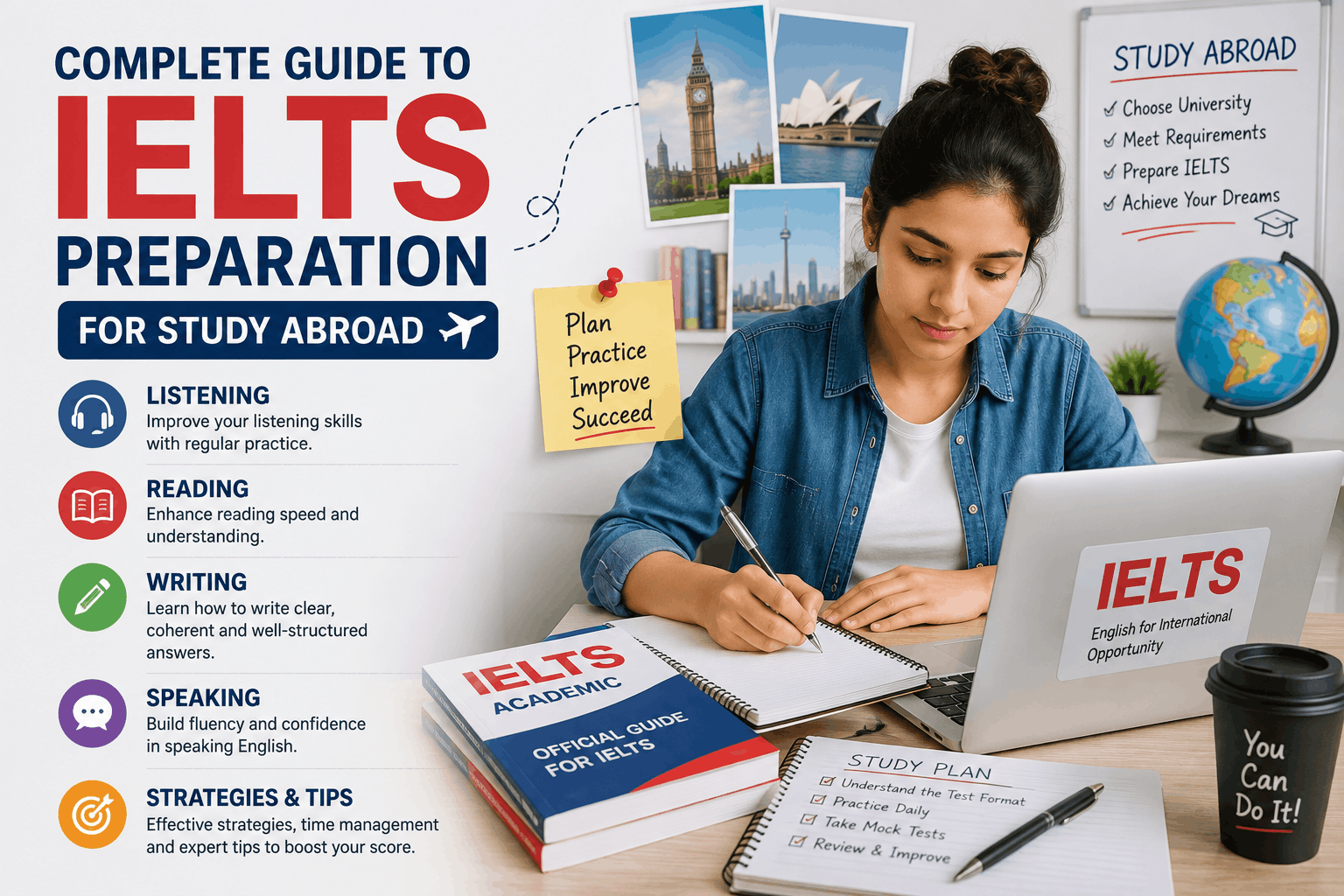
Complete Guide to IELTS Preparation for Study Abroad
IELTS is one of the most widely recognised English-language tests for international education. For students planning to study abroad, achieving the required IELTS score can be an important part of the university admission process.
For undergraduate and postgraduate study, IELTS Academic is generally the relevant test. It assesses four skills: Listening, Reading, Writing and Speaking. The Academic test takes approximately 2 hours and 45 minutes in total.
However, IELTS requirements can vary by university, programme and country. Students should always check the exact English-language requirements of their chosen institution before booking their test.
1. Understand the IELTS Test Format
Before starting your preparation, understand what you will be tested on.
| Section | Approx. Time | Key Focus |
|---|---|---|
| Listening | 30 minutes | Understanding conversations and presentations |
| Reading | 60 minutes | Comprehension, vocabulary and information analysis |
| Writing | 60 minutes | Academic writing and argument development |
| Speaking | 14 minutes | Fluency, vocabulary, grammar and pronunciation |
The Listening and Speaking sections are the same in Academic and General Training IELTS, while Reading and Writing are different.
2. Set Your Target Band Score
Don't begin preparation without knowing your target.
First, check your university's minimum IELTS requirement. Some programmes may also require a minimum score in individual sections, rather than only an overall score.
IELTS scores range from Band 1 to Band 9. An overall score is calculated from the four section scores and rounded according to IELTS scoring rules.
For example:
Listening 7.0 + Reading 6.5 + Writing 6.0 + Speaking 6.5 = Overall 6.5
Your target should therefore consider both the overall requirement and individual band requirements.
3. IELTS Listening Preparation
The Listening test contains four parts and 40 questions. You hear the recordings once, and different English accents may be used.
How to improve:
- Listen to English every day.
- Practise with official IELTS sample tests.
- Become familiar with different accents.
- Focus on keywords rather than trying to understand every word.
- Read questions before the recording begins.
- Pay attention to spelling and numbers.
- Practise different question types.
- Review your mistakes after every practice test.
Common question types include multiple choice, matching, form completion, note completion, table completion and sentence completion.
4. IELTS Reading Preparation
Academic Reading consists of three sections with 40 questions and a 60-minute time limit.
Key strategies:
Improve reading speed:
Read English articles, newspapers, academic materials and magazines regularly.
Learn skimming:
Quickly identify the main idea of a passage.
Learn scanning:
Search for specific names, dates, numbers, keywords or information.
Understand question types:
Practise True/False/Not Given, matching headings, multiple choice, sentence completion and other common formats.
Manage your time:
Don't spend too long on one difficult question.
Remember that IELTS Reading is not simply a test of English vocabulary. It also tests your ability to locate, understand and interpret information.
5. IELTS Writing Preparation
Academic Writing has two tasks. Task 1 requires at least 150 words, while Task 2 requires at least 250 words. Task 2 carries greater weight in the Writing score.
Task 1
You may need to describe:
- Graphs
- Tables
- Charts
- Diagrams
- Processes
Focus on identifying the key features and overall trends, rather than describing every small detail.
Task 2
You may be asked to discuss an opinion, argument or problem.
A strong essay generally includes:
- Introduction
- Main body paragraph 1
- Main body paragraph 2
- Additional paragraph where appropriate
- Conclusion
IELTS Writing is assessed using areas such as task response/achievement, coherence and cohesion, vocabulary, and grammatical range and accuracy.
Writing practice tip
Don't only write essays. Get your writing reviewed. Understanding why an answer received a particular band can help you identify recurring weaknesses.
6. IELTS Speaking Preparation
The Speaking test lasts approximately 11–14 minutes and has three parts. It is conducted as an interview with an examiner.
Part 1
Questions about familiar subjects such as:
- Home
- Family
- Studies
- Work
- Hobbies
- Interests
Part 2
You receive a topic and have one minute to prepare before speaking for up to two minutes.
Part 3
You discuss the topic in greater depth and answer more analytical questions.
How to improve Speaking:
- Speak English every day.
- Practise answering without memorising scripts.
- Record yourself speaking.
- Work on pronunciation.
- Expand your vocabulary naturally.
- Give reasons and examples when answering.
- Practise speaking for two minutes continuously.
- Don't panic when you make a small grammatical mistake.
Speaking is assessed on fluency and coherence, lexical resource, grammatical range and accuracy, and pronunciation.
7. Build Your Vocabulary
A strong vocabulary can improve all four IELTS skills.
Instead of memorising hundreds of isolated words, learn:
Word + Meaning + Example + Common Collocation
For example:
Significant
Meaning: Important or considerable
Example: There has been a significant increase in international student applications.
Useful vocabulary areas include:
- Education
- Technology
- Environment
- Health
- Society
- Business
- Globalisation
- Culture
- Employment
But remember: using simple and accurate English is better than using complicated words incorrectly.
8. Improve Your Grammar
You don't need to use extremely complicated grammar to achieve a good IELTS score. You need to demonstrate a range of structures accurately and appropriately.
Focus on:
- Tenses
- Articles
- Prepositions
- Subject-verb agreement
- Complex sentences
- Conditionals
- Relative clauses
- Passive voice
- Comparatives
- Punctuation
Keep a notebook of your recurring grammatical mistakes and review them regularly.
9. Use Official IELTS Practice Materials
Practice should closely reflect the real test.
Official IELTS resources provide sample tasks that help candidates understand the test format, practise under timed conditions and review their answers.
Official IELTS preparation resources
10. Take Regular Mock Tests
Mock tests help you measure your progress.
A good preparation cycle is:
Practice → Check → Identify mistakes → Improve → Practice again
Don't simply count your score. Analyse why you lost marks.
For example:
- Listening: spelling mistakes?
- Reading: poor time management?
- Writing: weak organisation?
- Speaking: hesitation or limited vocabulary?
This makes your preparation much more effective.
11. Create a Study Schedule
A realistic study plan is better than studying for long hours occasionally.
Example 6-Week IELTS Plan
Week 1:
Understand the format and take a diagnostic test.
Week 2:
Focus on vocabulary, grammar and Listening.
Week 3:
Focus on Reading strategies and question types.
Week 4:
Practise Writing Task 1 and Task 2.
Week 5:
Intensive Speaking practice and full mock tests.
Week 6:
Complete timed tests, review mistakes and focus on weak areas.
Adjust the schedule depending on your current English level and target score.
12. Avoid These Common IELTS Mistakes
❌ Memorising complete Speaking answers
❌ Using complicated vocabulary incorrectly
❌ Ignoring grammar
❌ Spending too much time on one Reading question
❌ Writing without understanding the question
❌ Practising only your strongest skill
❌ Taking mock tests without reviewing mistakes
❌ Waiting until the final week to practise Speaking
❌ Using unofficial or unreliable practice materials
❌ Booking the test without checking your university's requirements
Final IELTS Preparation Checklist
Before your test, make sure you can:
☐ Understand the complete test format
☐ Meet your university's required band score
☐ Complete Listening practice within the time limit
☐ Finish Reading within 60 minutes
☐ Write both Academic Writing tasks within 60 minutes
☐ Speak confidently about familiar and unfamiliar topics
☐ Understand your common grammar mistakes
☐ Use vocabulary naturally
☐ Complete several full mock tests
☐ Review and learn from your mistakes
Final Thoughts
Successful IELTS preparation is not about studying English for one or two weeks before the exam. It is about consistent practice, understanding the test format, identifying weaknesses and improving them systematically.
Start by setting your target score, understand the requirements of your chosen university, create a realistic study plan and use reliable practice materials. With regular preparation and the right strategy, you can approach your IELTS test with greater confidence.
Planning to study abroad? Global Education Service can guide students through university selection, admission, IELTS preparation guidance and student visa processing for their international education journey.